























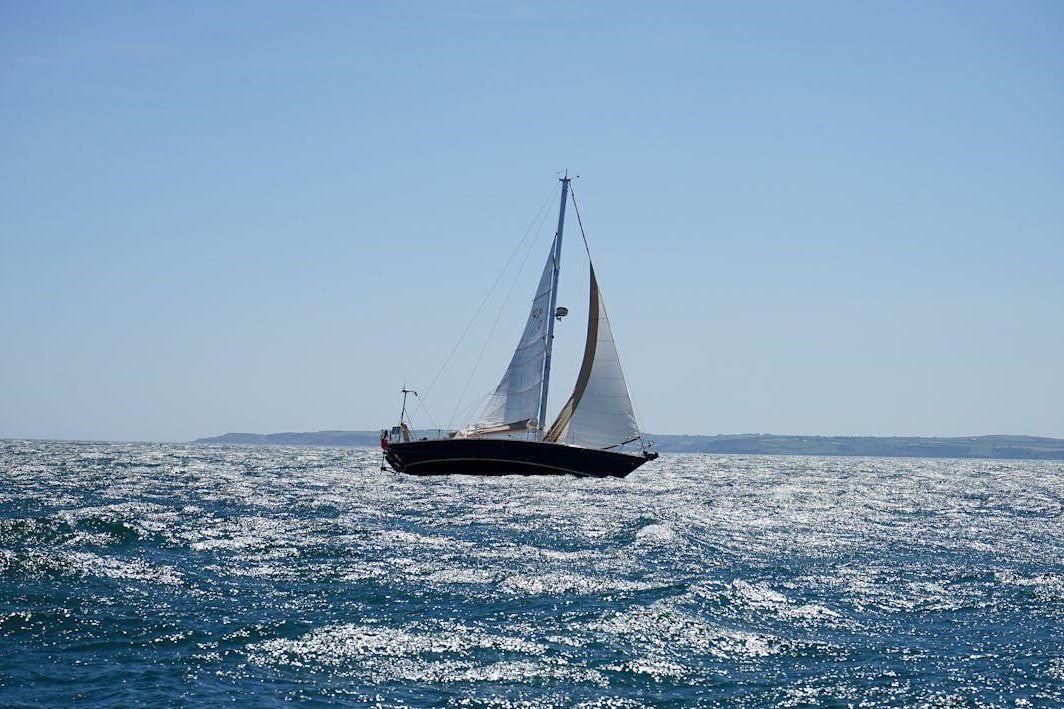

Sailing is all the rage. The world of coffee has indeed set sail in the spotlight and used the Vendée Globe to share the great news widely.
By 2030, 2035, or even 2050, depending on your point of view, "all our coffees will be transported by sail," we read on the websites of many coffee industry players or in the press.
Some admirable companies had already brought sailing transport back into fashion almost 10 years ago, particularly for wine with efficient connections between the Pays de la Loire and Scandinavia, or like Grains de Sail, Artemis and Anemos, Timbercoast or even Ecoclipper to other destinations and for other products.
The stakes seem high since maritime transport dominates the transport of goods, with 70% of tonne-kilometres transported across the world according to OECD data reported by the newspaper Le Monde .
So, we can only welcome the initiatives of players like TWOT , who for years have been offering roasters and importers the power of the wind to import their coffee, cocoa, mezcal and other products from the Tropics or across the Atlantic.
This formidable long-term initiative undoubtedly allows for the reduction of noise pollution at sea, as well as the reduction of illegal degassing, or that of the air linked to the use of one of the dirtiest fuels there is, by old tubs. But what about the reduction of CO2 emissions, in short, the loud and clear demand of many stakeholders to proclaim their commitment to CO2 sobriety? Does sailing boat really rhyme with efficiency? CO2, Does it really allow us to "significantly reduce the carbon footprint of coffee" as is said everywhere? For us, there is an error of judgment which explains why we do not have, to L'Arbre à Café , yet taken the step, nor financed this great seductive and inspiring adventure.
We explain why!
1. An exorbitant cost
Shipping a container of green coffee (18T) by intercontinental sea freight (Brazil-Le Havre) costs, all costs included, less than $2,000 or €0.11/kg transported .
The quotes we have been requesting for almost 15 years have convinced us of the sailing solution, and the figures put forward by the leader in this solution, show 1€/kg, which is 10 times more than traditional sea freight ( Fresh Coffee, Clean Ocean ).
The difference is therefore massive. The sail costs an additional $16,000 per container...
2. Very low CO2 reductions
Although maritime freight represents 70% of the tonne-km transported worldwide, it is responsible for "only" 16% of freight emissions, according to the OECD!
Thus, for 1 container of green coffee, the transport from Brazil to Le Havre fluctuates between 700 and 1400kg eq. CO2, according to searates.com . This is therefore not very much compared to the kg of coffee.
With sailing, you certainly bring these emissions to their smallest portion since TOWT announces 2g/tonne/km or for 18 tonnes over the 8400km which separate the two ports (according to fluentcargo.com ) 302kg of CO2. Maritime freight therefore emits between 2 and 5 times more.
The reduction in CO2 emissions by switching from normal freight to sailing is therefore approximately 1,100 to 400 kg. A feat, but at what cost and therefore how effective is this?
3. A very high cost per tonne of CO2 avoided
If I take the additional cost of sailing transport of $16,000 for a CO2 reduction of between 400 and 1,100 kg, I arrive at a cost per ton of CO2 avoided of between $14.54 and $40.
4. Very relative carbon efficiency
We can therefore say that virtue The ecological impact of sailing transport is not in the carbon footprint of the coffee industry. With $16,000, I have many other things I can do to reduce my emissions more effectively. By switching to electric for distribution, for example: we compensate for the price difference between a diesel van and an electric one, and in 30,000km/year we actually reduce our footprint by 3.6 tonnes of CO2 according to figures from mobilygreen , i.e. between 9 and 3.6 times more than with sailing , by changing our air conditioning and heating we do the same, by switching to organic, we do even better.
5. A sail that hides the forest
HAS L'Arbre à Café , thanks to the various CO2 assessments carried out by @EcoAct or @Aktio, we have thus realized that intercontinental transport only represents a minority of our emissions! It is counterintuitive but the The CO2 problem of dry tropical products transported by container is not the transport by ship but many other things.
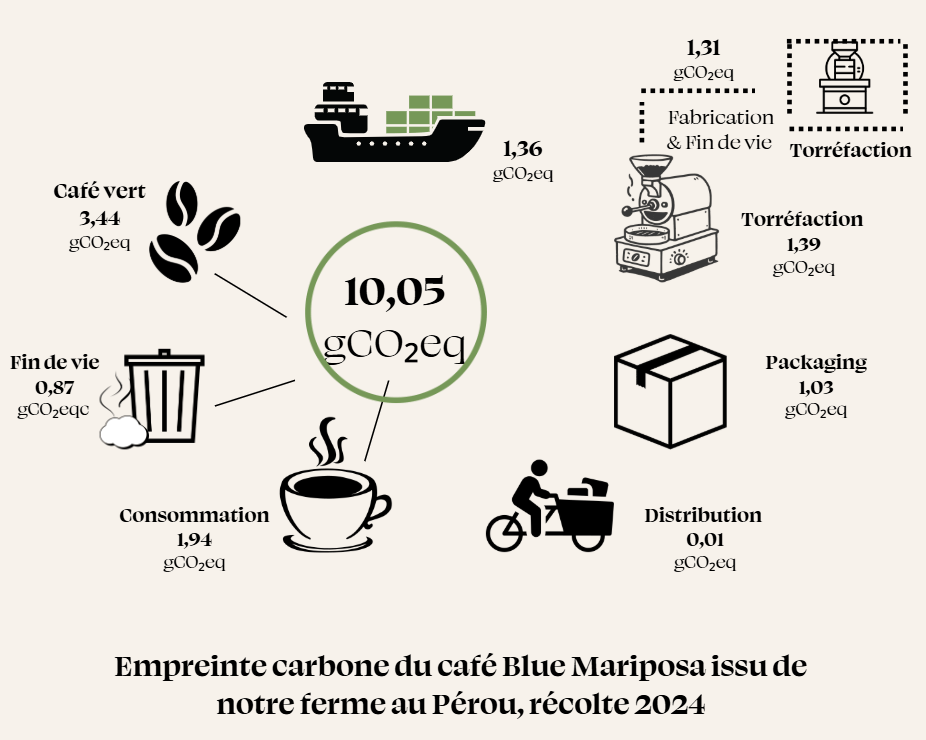
Let's take the example of our latest assessment carried out last fall (October 2024) in collaboration with Aktio. Transport, all types combined, is responsible for 20% of our total emissions . That's 1/5.
So this is only the 4th position of issue after purchases of goods, use and consumption and what are called other fixed assets.
Agriculture is often the second largest emitter when it is conventional, as the Quantis study for Nespresso or the studies of the SCA (Specialty Coffee Association) remind us. For us, the first two items are our priority: usage and agriculture . It is therefore more relevant to invest in regenerative agriculture than in intercontinental transport. This is also in line with the distribution of emissions on a global scale, almost 30% for agriculture, compared to 3% for maritime freight.
6. Transport is a carbon priority, but not intercontinental transport, which represents less than 2% of our emissions.
THE "transport" is broken down into two main "sources":
- the transport of goods , itself divided into upstream and downstream ,
- and the travel of customers and employees, provided that scope 3 is included in its balance sheet. Which we obviously do at L'Arbre à Café .
However, for us, passenger travel (company employees, store customers and business trips) represents almost half of our CO2 emissions from the transport sector, or 10% of our total balance sheet !
As you will have understood, upstream (purchases for the company) and downstream (transport for sales) freight transport "only" accounts for half of the emissions linked to transport, and therefore 10% of our total emissions.
Let's go further.
For-sale transportation accounts for two-thirds of our transportation emissions! That's why we only work with companies that implement emission reduction initiatives—clean vehicles for national use, and bicycles for local use—and offsetting commitments.
L'Arbre à Café is nothing exceptional in this area. We have even decided to export very little directly to the end customer. Imagine the carbon footprint of a 500g package of coffee to China... Colleagues who specialize in BtoC exports, to Asir for example, would see the transport part on sale literally exploded.
Let's continue.
The remaining third is primarily taken up by road transport of goods... once the goods (accessories, machines, coffee, sugar, etc.) have arrived at the port.
It is therefore urgent to address the carbon footprint of road transport and to develop alternatives to road transport.
As you will have understood, intercontinental transport by boat only generates 9% of our CO2 emissions from the transport sector... or 2% of our total emissions...
From a CO2 emissions point of view, it is therefore not a priority.
The idea is to help change maritime freight and work towards alternatives, but invoking false or even superfluous benefits does not help us to sort things out, choose our battles and our commitments. We therefore invite stakeholders in the sector, and first and foremost, importers and wholesalers, to work towards low-emission road transport.